The Office for Digital Identities and Attributes (OfDIA) is introducing machine-readable technology to the digital verification services register. This will allow businesses and public authorities to check the register securely and at scale.
The current register
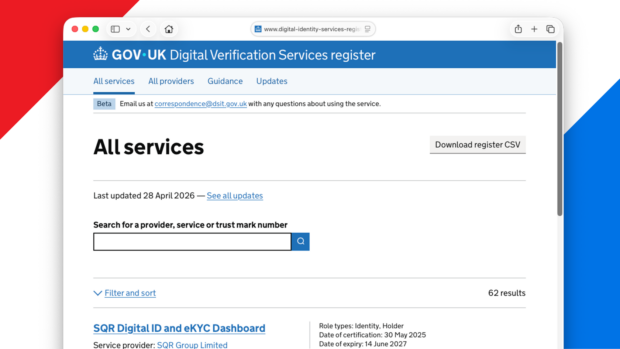
The current digital verification services (DVS) register is a GOV.UK list of services that meet government rules and standards. It was designed to help businesses and individuals to search and browse information about registered digital verification services.
This works well for occasional checks. However, as digital verification services become more widely adopted, we need the register to support faster, more secure checks at a larger scale.
The machine-readable register
Last year, we did discovery work to explore how to make the register machine-readable. We are now implementing technology, known as public key infrastructure (PKI), which will allow businesses and public authorities to programmatically check the list of registered services. This will make checks against the register more secure and scalable.
How will programmatic checks support the sector
Programmatic checks will support secure access to public authority data
Earlier this year, we explained how information gateway powers introduced in the Data (Use and Access) Act 2025 will allow public authorities to share data with trusted digital verification service providers at the individual’s request.
However, before a public authority, like DVLA or the Home Office, can share any data, it must check that the digital verification service is registered. Relying on a person to carry out these checks every time would not be practical.
The machine-readable register will allow public authorities to carry out these checks securely and at scale. This will help unlock public authority data for safe and trusted use across the economy.
How it could work:
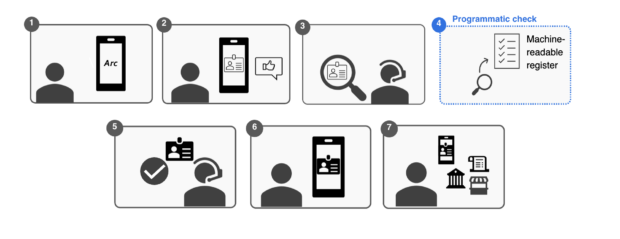
- An individual creates a digital credential using a digital verification service. They input data, such as their name and date of birth.
- The individual agrees to share this data with a public authority.
- The service sends a request to a public authority, such as DVLA or the Home Office, to validate the data.
- The public authority receives the request and checks that the service is registered using the machine-readable register.
- Once the public authority has confirmed that the service is on the register, they share the individual's data.
- The individual's data is validated using government data.
- The individual now has a trusted digital credential they may use across the economy instead of a physical document.
Programmatic checks will make it easier for pubs, clubs, restaurants and shops to accept digital proof of age for alcohol sales
Last week the Home Office laid regulations that will allow licensed premises in England and Wales to rely on digital age verification checks. Once this legislation comes into force, people will be able to prove they are old enough to buy alcohol using a registered digital verification service instead of a passport or driving licence.
However, before accepting digital proof of age, businesses will need to check that the services involved in the transaction are registered. Again, relying on a person to check the register at the point of sale would not be practical.
The machine-readable register will allow businesses to carry out these checks quickly, securely and at scale. This will make it easier for businesses to rely on digital age verification checks for alcohol sales.
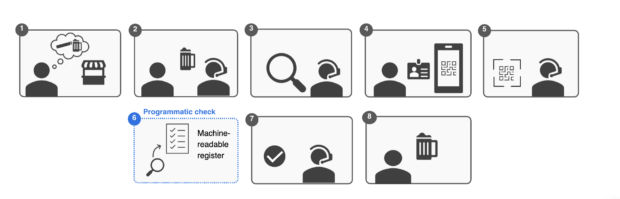
- An individual visits the supermarket to purchase alcohol.
- The individual takes alcohol to the cash register.
- The supermarket staff request to see proof of age.
- The individual presents proof of age using a digital verification service.
- Using a different digital verification service, the supermarket staff scan the digital proof of age.
- The scan checks that the digital proof of age is provided by a registered service using the machine-readable register.
- The supermarket staff confirm the service is on the register and accept the digital proof of age to process the alcohol sale.
- The purchase is complete within a few seconds.
Next steps
A machine-readable digital verification services register will help grow the digital identity sector. It will introduce programmatic checks which are more secure and scalable. This will make it quicker and easier for businesses and public authorities to check whether a service is government registered and can be trusted.
This month, we started the beta development phase. We will work with digital verification service providers, businesses that rely on digital verification checks, and public authorities to test and improve the solution.
Testing will continue throughout Summer and Autumn 2026, with a minimum viable product expected to launch in Winter 2026.
If you would like to take part in beta testing, email digital.identity.register@dsit.gov.uk.